CNS Tumours
👩⚕️ Take time to learn these core tumour patterns
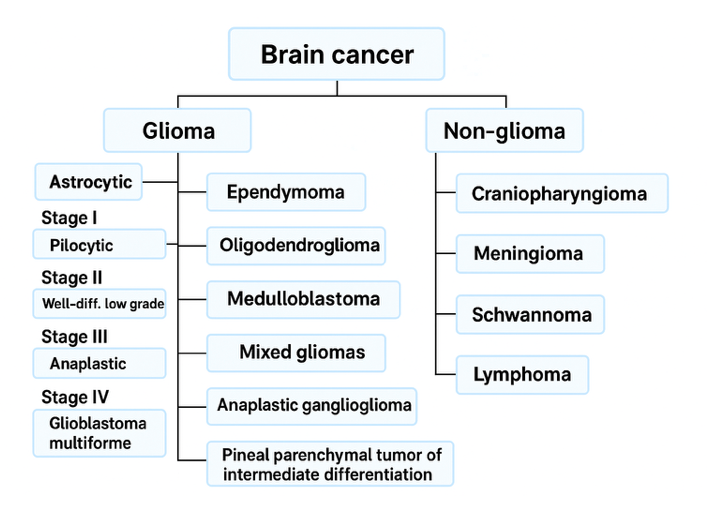
The most common primary brain tumour in adults is a glioma, specifically astrocytomas, with glioblastoma being the most aggressive type.
Glioblastoma multiforme shows central necrosis, ring enhancement, and characteristic cross-midline spread through the corpus callosum — the classic “butterfly glioma.”
In children, the most common brain tumour is pilocytic astrocytoma, a typically cerebellar WHO grade I tumour with excellent prognosis.
👩⚕️ Now let's work through these high-yield exam questions. Try to learn everything here!
What is the most common primary brain tumour in adults?
Gliomas — especially astrocytomas. Glioblastoma multiforme is the most common and most aggressive type.
A man has headache, confusion, and right hemiparesis. CT shows a 4 cm left frontal lesion with central necrosis crossing the midline via the corpus callosum and extensive edema. Diagnosis?
- [[Glioblastoma multiforme::Glioblastoma multiforme, a high-grade astrocytoma, is the most common primary brain malignancy in adults, characterized by central necrosis, ring enhancement, and cross‑midline infiltration (“butterfly glioma” spread across the corpus callosum). It’s rare in kids!]]
- ((Central neurocytoma::Intraventricular in young adults))
- ((Ependymoma::Periventricular, child, arise in 4th ventricle and grow via foramina of Luschka / Magendi))
- ((Meningioma::Extra‑axial, dural‑based, homogeneous))
- ((Oligodendroglioma::Calcified, slower growth, frontal lobes but no butterfly pattern))
What is the most common primary brain tumour in children?
Pilocytic astrocytoma
Where are pilocytic astrocytomas typically located?
Pilocytic astrocytomas are typically located in the cerebellum (posterior fossa)
What classic histological features are seen in pilocytic astrocytoma?
Rosenthal fibres and biphasic architecture.
Which is the most common malignant brain tumour in children?
- [[Medulloblastoma::Although medulloblastoma is the most common malignant brain tumour in children, it is not the most common overall]]
- ((Ependymoma::Ependymomas arise from the ependymal lining of the ventricles, particularly the fourth ventricle in children. They are less common than pilocytic astrocytomas and often present with obstructive hydrocephalus))
- ((Pilocytic astrocytoma::A WHO grade I astrocytic tumour with excellent prognosis; classically located in the cerebellum of children, characterised histologically by Rosenthal fibres and biphasic architecture))
- ((Craniopharyngioma::A benign epithelial tumour derived from Rathke’s pouch remnants, commonly arising in the suprasellar region, causing visual disturbance and growth failure))
Pilocytic astrocytoma is the most common brain tumour in children overall but it is typically a benign WHO grade I tumour. Medulloblastoma is the most common malignant brain tumour in children.
Which tumour typically presents with visual disturbance and growth failure?
Craniopharyngioma
Craniopharyngioma is a suprasellar tumour arising from Rathke’s pouch remnants that commonly compresses the optic chiasm (visual disturbance) and disrupts pituitary function (growth failure).
Where do ependymomas typically arise in children?
Ependymomas arise from the ependymal lining of the ventricles, particularly the fourth ventricle in children and may extend through the foramina of Luschka and Magendie.
How do ependymomas typically present?
Ependymomas often present with obstructive hydrocephalus.
What is a central neurocytoma and where does it arise?
An intraventricular tumour occurring in young adults, usually within the lateral ventricles.
How does a meningioma appear on imaging?
Extra-axial, dural-based, homogeneously enhancing — does not cross midline.
What imaging characteristic suggests oligodendroglioma?
Calcification with slow growth in the frontal lobes.
What tumour arises from Rathke’s pouch remnants?
Craniopharyngioma, usually suprasellar, compresses the optic chiasm (visual disturbance) and disrupts pituitary function (growth failure)