Parasympathetic Pathways of the Head
👩⚕️ There are four parasympathetic pathways of the head you need to memorise very well. We're going to cover those four pathways here.
Ciliary muscles & pupillary sphincters
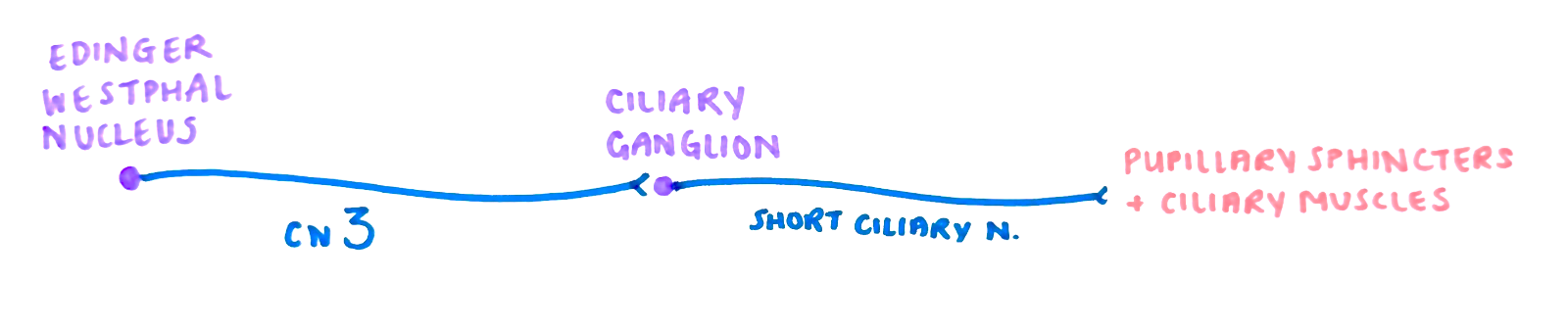
Pre-ganglionic parasympathetic fibres travel from the Edinger–Westphal nucleus within the oculomotor CN III to synapse in the ciliary ganglion. Post-ganglionic fibres then pass through the short ciliary nerves to innervate the pupillary sphincter muscle, which constricts the pupil, and the ciliary muscles, which control lens accommodation.
Summary:
Edinger-Westphal nucleus → Oculomotor CN III → Ciliary ganglion → Short ciliary nerves → Pupillary sphincter and ciliary muscles
Lacrimal apparatus
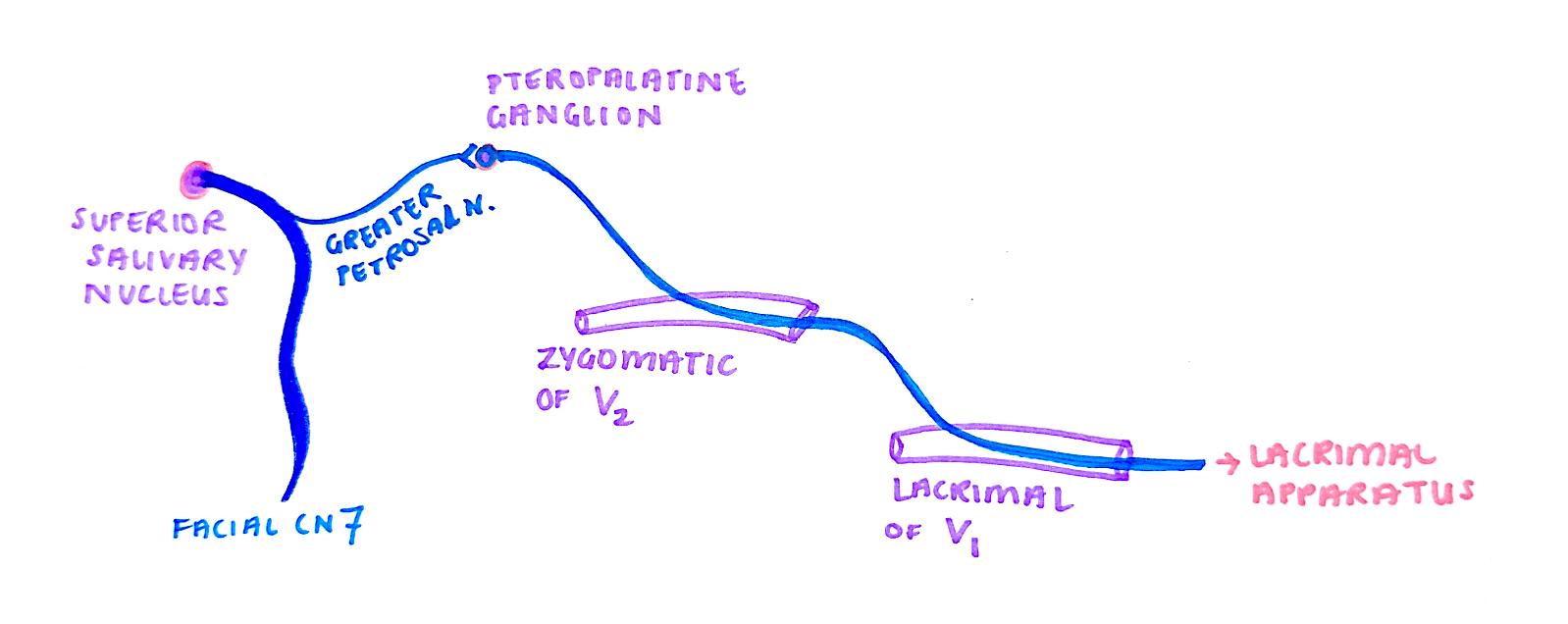
Pre-ganglionic parasympathetic fibres arise in the superior salivatory nucleus and travel within the facial CN VII. They pass through the geniculate ganglion without synapsing and continue as the greater petrosal nerve to synapse in the pterygopalatine ganglion. Post-ganglionic fibres then hitchhike on branches of the zygomatic branch of the trigeminal V₂ maxillary nerve and subsequently the lacrimal branch of the trigeminal V₁ ophthalmic nerve to reach the lacrimal apparatus, where they provide parasympathetic input to stimulate tear secretion.
Summary:
Superior salivary nucleus → Facial CN VII → Greater petrosal n. → Pterygopalatine ganglion → Joins zygomatic branch of trigeminal’s maxillary CN V2 → Joins the lacrimal branch of V1 → Lacrimal apparatus
Sublingual and submandibular glands
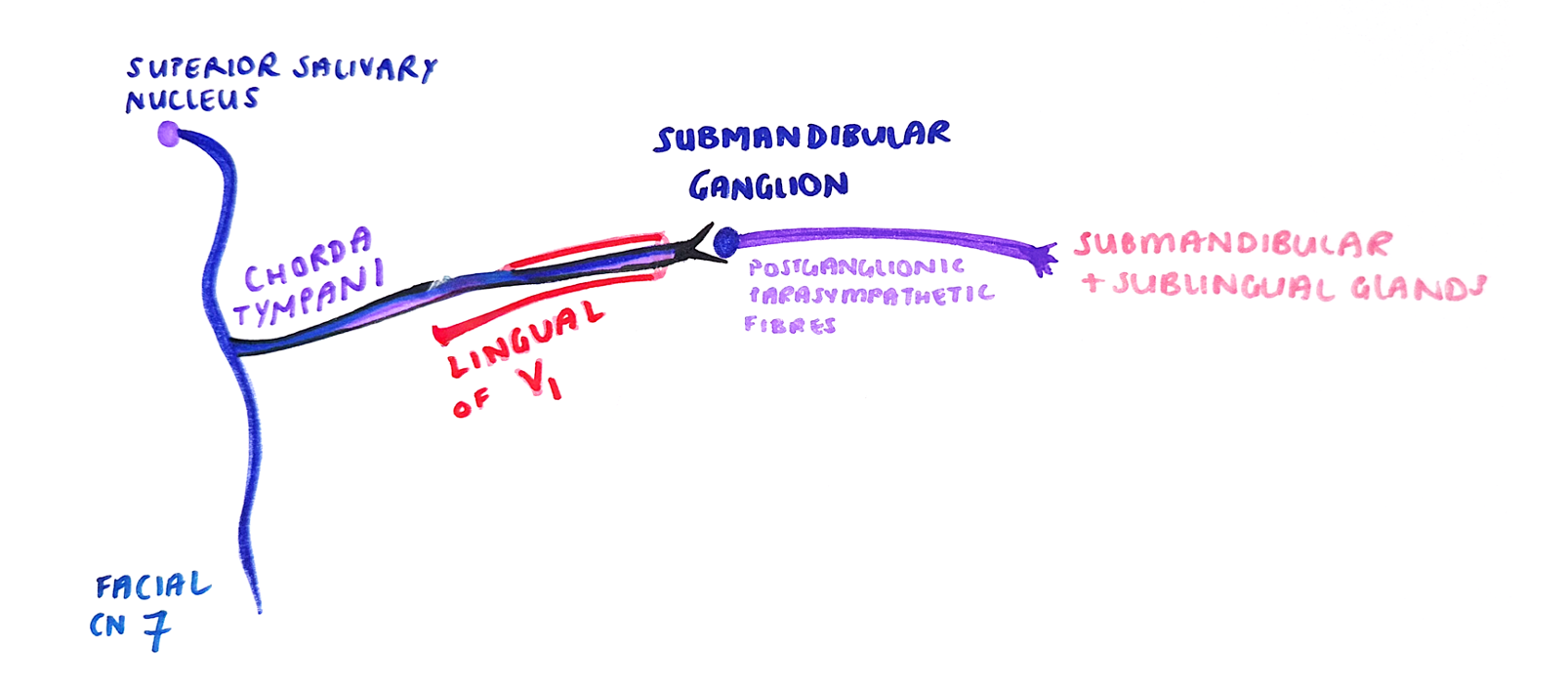
Pre-ganglionic parasympathetic fibres originate in the superior salivatory nucleus and travel within the facial CN VII before branching off as the chorda tympani. These fibres pass through the middle ear cavity and join the lingual nerve of the trigeminal V3 mandibular nerve, to reach the submandibular ganglion, where they synapse. Post-ganglionic fibres then supply the submandibular gland directly, while additional fibres continue along branches of the lingual nerve to innervate the sublingual gland. This pathway provides parasympathetic stimulation that increases salivary secretion from both glands.
Summary:
Superior salivary nucleus → Facial CN VII → Internal acoustic meatus → gives off the Chorda tympani → Joins the lingual nerve of trigeminal’s mandibular CN V3 → Submandibular ganglion → Parasympathetic supply to submandibular and sublingual glands
Parotid gland
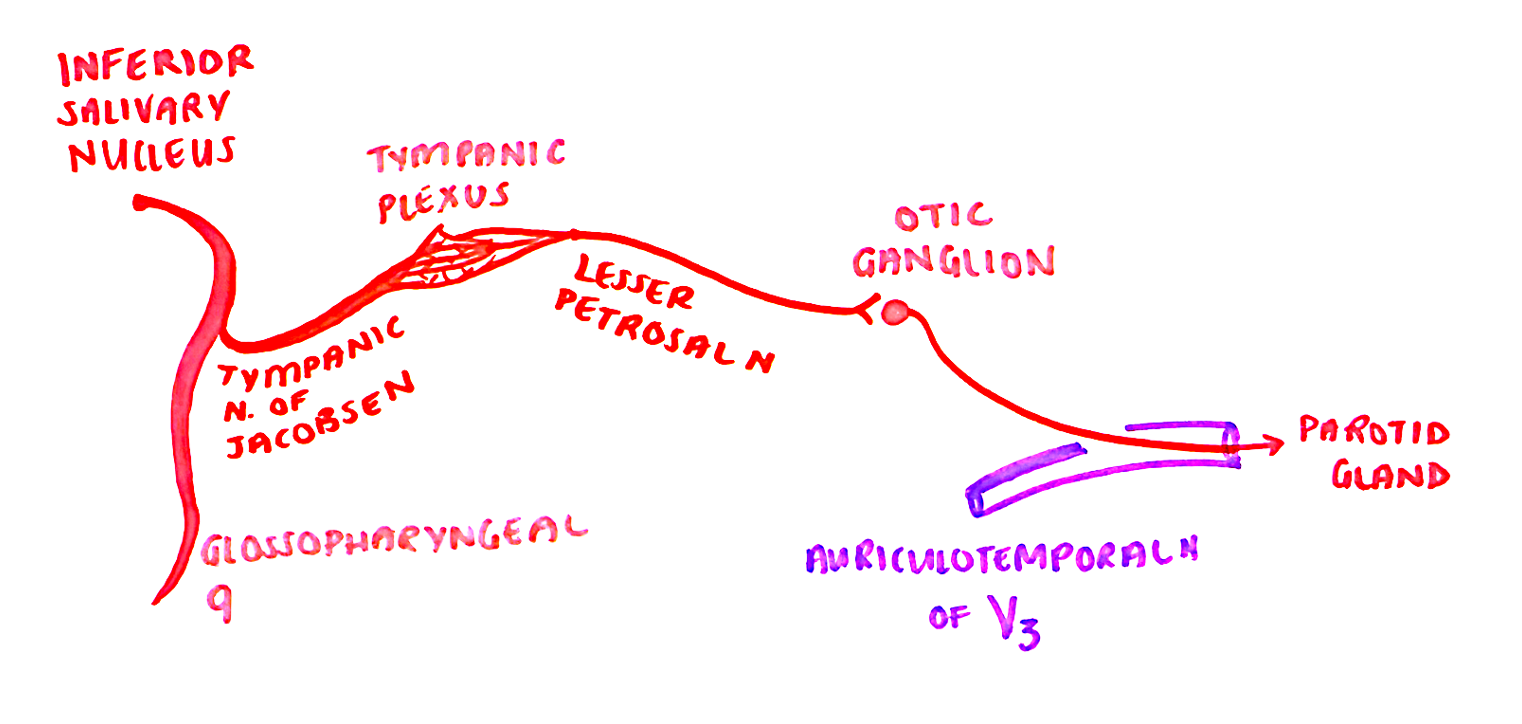
Pre-ganglionic parasympathetic fibres originate in the inferior salivatory nucleus and travel within the glossopharyngeal CN IX before branching off as the tympanic nerve of Jacobsen. These fibres pass through the jugular foramen and enter the middle ear to form the tympanic plexus, then continue as the lesser petrosal nerve to exit the skull through the foramen ovale and reach the otic ganglion, where they synapse. Post-ganglionic fibres then hitchhike along the auriculotemporal nerve of the trigeminal V3 mandibular nerve to innervate the parotid gland. This pathway provides parasympathetic stimulation that increases salivary secretion from the parotid gland.
Summary:
Inferior salivatory nucleus → Glossopharyngeal CN IX → Tympanic n. of Jacobson → Passes through the jugular foramen and enters the middle ear to form the tympanic plexus → Lesser petrosal n. → Exit the skull through the foramen ovale → Otic ganglion → Joins the auriculotemporal branch of V3 → Parotid gland
👩⚕️ Now, some MCQs
A patient suffers an orbital floor fracture and now has loss of lacrimation. Which nerve is most likely affected?
- ((Lacrimal::The lacrimal nerve is sensory only; it provides sensory supply to the lacrimal gland, conjunctiva, and upper eyelid.))
- ((Facial CN VII::The facial nerve supplies the muscles of facial expression and carries taste fibres from the anterior tongue.))
- [[Greater petrosal::The greater petrosal nerve carries parasympathetic fibres from the facial nerve to the pterygopalatine ganglion, which then supply the lacrimal gland.]]
- ((Auriculotemporal::The auriculotemporal nerve carries parasympathetic fibres to the parotid gland after receiving fibres from the otic ganglion.))
A patient presents with loss of lacrimation. Which ganglion is involved?
- ((Otic::The otic ganglion carries parasympathetic fibres from glossopharyngeal CN IX to the parotid gland.))
- ((Submandibular::The submandibular ganglion carries parasympathetic fibres from facial CN VII to the submandibular and sublingual glands.))
- [[Pterygopalatine::The pterygopalatine ganglion receives parasympathetic fibres from the greater petrosal nerve and relays them to the lacrimal gland.]]
- ((Ciliary::The ciliary ganglion carries parasympathetic fibres from oculomotor CN III to the sphincter pupillae and ciliary muscles.))
💥 If it's loss of lacrimation or 'dryness of the eyes' due to any sort of traumatic or iatrogenic injury such as orbital floor fracture or parotidectomy with radiotherapy - think Pterygopalatine ganglion
In summary, the four parasympathetic ganglia in the head and neck are:
- Ciliary ganglion to the ciliary and pupillae sphincter muscles
- Pterygopalatine (aka sphenopalatine) ganglion to the lacrimal glands
- Submandibular ganglion to the submandibular and sublingual glands
- Otic ganglion to the parotid glands