Shock, Vasopressors & Inotropes
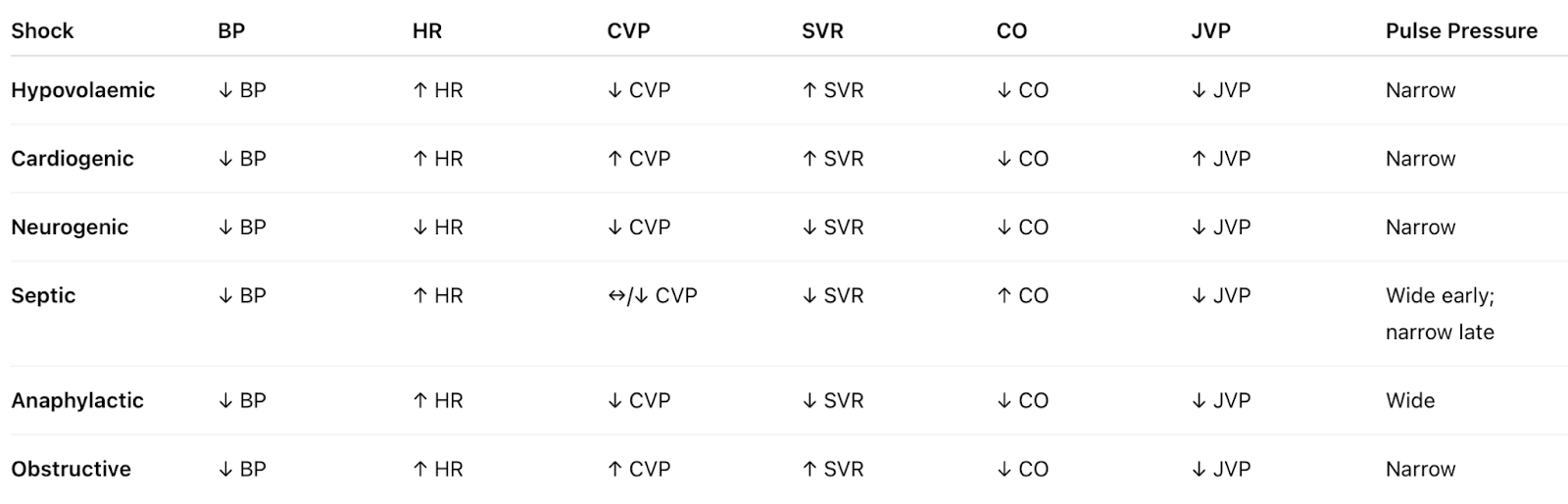
- A patient presents to the Emergency Department with decreased heart rate, low central venous pressure, low systemic vascular resistance, and low cardiac output. What is the most likely type of shock?
- [[Neurogenic::In neurogenic shock, all parameters are ↓: ↓BP, ↓HR, ↓CVP, ↓SVR, ↓CO; Bradycardia occurs due to loss of sympathetic tone, following spinal cord injury or brainstem insult, typically after spinal cord trauma above T6, whereas most other shock types present with tachycardia as a compensatory response]]
- ((Cardiogenic::Cardiogenic shock is characterised by ↓BP, ↑HR, ↑CVP, ↑SVR and ↓CO))
- Septic
- Hypovolaemic
- A person is hit in the precordial region. He is conscious but has raised JVP and narrow pulse pressure. What type of shock is this?
- [[Obstructive::Obstructive shock occurs when mechanical obstruction impedes cardiac filling or output. The raised JVP indicates the impaired venous return, and the narrow pulse pressure indicates decreased stroke volume. It would be due to a traumatic cardiac tamponade until proven otherwise, in this scenario from the precordial trauma.]]
- Neurogenic
- Septic
- Hypovolaemic
- In which type of shock is there an increase in systemic vascular resistance?
- [[Hypovolaemic::Hypovolaemic shock leads to decreased preload due to a low circulating volume; the body compensates by sympathetic activation, vasoconstriction and ↑SVR as well as tachycardia to maintain cardiac output. In other types of shock, SVR is reduced because the normal tone of the arterial vasculature is lost, allowing widespread vasodilation and running‑off of blood into the capacitance vessels. This occurs due to loss of sympathetic outflow in neurogenic/spinal shock, due to inflammatory mediators in septic shock, and due to mast cell/basophil degranulation in anaphylactic shock.]]
- A 55-year-old man presents after collapsing. He has warm peripheries and his vitals are as follows: HR 124 bpm, BP 60/30 mmHg and RR 34. Diagnosis?
- ((Cardiac failure::Cool peripheries, signs of congestion; hypotension is less common unless decompensated))
- ((Haemorrhage::Cool clammy skin due to sympathetic vasoconstriction))
- ((Hypovolemia::Cool peripheries as blood is shunted to core))
- [[Sepsis::In early septic shock, peripheral vasodilation causes warm, flushed skin despite hypotension, along with tachycardia, and tachypnoea; as shock progresses, cold peripheries and organ hypoperfusion follow]]
- ((Pulmonary embolus::Hypoxia, chest pain, and signs of right heart strain, not warm peripheries))
- A postoperative patient becomes restless. Urine output has been: 80 ml, 80 ml, 80 ml, 0 ml, 0 ml, 0 ml over the last 5 hours. What is the most likely cause?
- Blocked catheter::✔
- A 58-year-old man underwent an emergency appendicectomy. Postoperatively, he develops signs consistent with sepsis. Which of the following combinations of physiological parameters heart rate, systemic vascular resistance and cardiac output, best reflects the haemodynamic state in sepsis?
- ↓HR, ↓SVR, ↑CO↑HR, ↑SVR, ↓CO
- ↑HR, ↓SVR, ↑CO::In early (compensated) sepsis, systemic inflammation leads to vasodilation (↓SVR), and increased sympathetic drive leads to tachycardia (↑HR), and a high-output state (↑CO); As sepsis progresses or decompensates, cardiac output may fall, leading to cold shock]]
- ↓HR, ↑SVR, ↓CO↑HR, ↓SVR, ↓CO
- A patient after an RTA presents with restlessness, thirst, increased capillary refill time, cool peripheries, low urine output, and low blood pressure. Which of the following hemodynamic profiles is consistent with hypovolemia?
- ↓HR, ↓SVR, ↓CO
- [[↑HR, ↑SVR, ↓CO::In hypovolemic shock, the body compensates with ↑HR and vasoconstriction (↑SVR) to maintain perfusion, but cardiac output falls due to reduced preload]]
- ↑HR, ↑SVR, ↓CO
- ↑HR, ↓SVR, ↓CO
- A patient in a traffic accident presents with BP 70/30, HR 145 and RR 30. What class of hypovolaemic shock is this?Class II Class III
- Class I
- Class II
- Class III
- [[Class IV::✔ If BP drops, it is automatically class 3 or 4. With a HR of < 120, it’s class 3. HR or 140 makes it class 4; In class III shock, we expect significant metabolic acidosis; an ABG would show base deficit -6 to -10 mEq/L]]
- A 30-year-old with head trauma has BP 125/80 mmHg and ICP 19 mmHg. What is his cerebral perfusion pressure?
- [[76:: MAP = DBP + ⅓(SBP–DBP) ; 80 + ⅓(45) = 95. CPP = MAP–ICP ; CPP = 95–19 = 76 mmHg]]
- Cerebral Perfusion Pressure = [[Mean Arterial Pressure::Diastolic BP + (⅓ [Systolic BP – Diastolic BP])]] – Intracranial Pressure
- CPP = MAP – ICP
- CPP = ⅓ [sBP – dBP] + dBP – ICP
- If CVP > ICP, as in superior vena cava syndrome, use the CVP instead of ICP
- Normal CCP in adults is 60 to 80 mmHg
- Critical threshold: CPP < 50 mmHg often leads to cerebral ischemia
- In traumatic brain injury: maintain CPP 60 to 70 mmHg
- In SAH or stroke: often aim for CPP ≥ 70 mmHg
- Cerebral autoregulation maintains constant blood flow across MAPs of roughly 50 to 150 mmHg
- Cerebral perfusion pressure if BP is 110/80 mmHg and ICP is 18 mmHg?
- [[72 mmHg::CPP = MAP – ICP; MAP = 80+⅓(30) = 90, so 90 – 18 = 72]]
- Which is the first event that occurs in shock?
- Baroreceptor stimulation::✔
- Sympathetic stimulation
- Adrenaline activation
- Renin activation
- A 26-year-old man is admitted to A&E with multiple peripheral fractures. He is clinically shocked. Which is the structure responsible for the first hemostatic response to a fall in systemic arterial blood pressure?
- [[Baroreceptor::✔Baroreceptor stimulation triggers increased sympathetic outflow, adrenaline release from the adrenal medulla, and renin release from juxtaglomerular cells to initiate RAAS, and it reduces parasympathetic (vagal) activity]]
- Chemoreceptor
- Renin
- Neurohypophysis
- In hypotension, where would the first baroreceptor response occur?
- [[Carotid sinus::The carotid sinus at the bifurcation of the common carotid artery, contains baroreceptors that are highly sensitive to sudden drops in arterial pressure. It’s innervated by the glossopharyngeal CN IX. They play a dominant role in short-term BP regulation. It responds first and more sensitively to changes in pressure than the aortic sinus.]]
- ((Superior vena cava::Not primary baroreceptor sites))
- ((External carotid artery::Not primary baroreceptor sites))
- ((Carotid body::Involved in chemoreception (responds to changes in O₂, CO₂, and pH), not pressure))
- ((Aortic sinus::The aortic sinus sits just above the aortic valve where the coronary arteries branch off the aorta. The baroreceptors located within the aortic arch wall, near the aortic sinuses, are innervated by the aortic nerve, which is a branch of the vagus CN X. The aortic sinus baroreceptors are less sensitive than carotid sinus receptors. They have a higher threshold and are more important during large changes, during sustained hypotension or major volume shifts.))
- Which neurotransmitter is released by preganglionic autonomic fibres?
- ((Noradrenaline::Released from postganglionic sympathetic fibres (except sweat glands)))
- ((Dopamine::Not a major autonomic transmitter))
- ((GABA::Inhibitory CNS neurotransmitter))
- [[Acetylcholine::Released by all preganglionic sympathetic and parasympathetic neurons]]
- Serotonin::CNS neurotransmitter, not preganglionic autonomic))
All preganglionic autonomic fibres, regardless of whether they belong to the sympathetic or parasympathetic nervous system, release acetylcholine (ACh) at the ganglion.
- Which neurotransmitter is released from the sympathetic nervous system to stimulate the adrenal medulla?
- Acetylcholine::Preganglionic sympathetic neurons release acetylcholine, which then binds to nicotinic receptors on the chromaffin cells of the adrenal medulla, stimulating the release of adrenaline (80%) and noradrenaline (20%).
- Which drug is a precursor of noradrenaline?
- [[Dopamine::Converted by dopamine β-hydroxylase into noradrenaline in sympathetic nerve terminals; Tyrosine → L-DOPA → Dopamine → Noradrenaline → Adrenaline]]
- A 70 kg patient is being monitored postoperatively. Below what urine output would you begin to be concerned about renal perfusion or function?
- [[35 mL/hr::✔ In adults, minimum acceptable urine output is 0.5 mL/kg/hr; 70 × 0.5 = 35 mL/hr]]
- A motorist in an RTA arrives with left‑leg and lower abdominal pain, BP 85/60 mmHg, HR 110 bpm, conscious and talking. Management?
- IV morphine
- O‑negative blood transfusion
- [[Massive haemorrhage protocol::O negative blood is universal donor blood]]
- After a collision between two boats, a conscious patient, BP 110/80, HR 110, complains of severe leg and abdominal pain. What is the best initial management?
- Massive haemorrhage protocol::✔
- IV morphine
- Transfer to neurosurgery
- A young male presents to A&E with a self-inflicted neck wound. He is alert, breathing, and talking, but has severe external bleeding and BP 80/40. Initial management?
- Explore wound to find bleeding point to ligate Transfuse blood
- Pressure on wound::✔
(c)ABCD for catastrophic haemorrhage: If large bleeds are present, immediately act for haemostasis with direct pressure, haemostatic dressing application, or tourniquets.
- A patient after splenectomy receives 3 L of 5% dextrose. What is the initial change expected?
- Raised jugular venous pressure Increase urine osmolality
- Decrease urine osmolality::✔
- A man presents with a short history of vomiting and abdominal distention. On examination, he has cold peripheries, BP is 95/70, and pulse is 100. He is given 4 litres of 5% dextrose. What will be the effect?
- Increase osmolality
- [[Decrease osmolality::5% dextrose is not a true plasma expander: The glucose is rapidly metabolised, leaving behind free water, a hypotonic solution, and the free water distributes throughout total body water. About ⅔ enters the intracellular space and only ⅓ remains extracellular. As a result, there is very little intravascular expansion, so JVP and BP do not rise significantly. Because plasma becomes diluted, plasma osmolality falls. The kidney responds by excreting more dilute urine, so the initial measurable change is a decrease in urine osmolality.]]
- Decrease extracellular fluid
- Decrease intracellular fluid
- Increase interstitial fluid
- An 11-year-old girl is unwell, peripherally shut down. She weighs 32kg. Initial fluid management?
- 320 cc glucose 5% STAT
- 640 cc glucose 5% STAT
- [[640 cc saline 0.9% STAT::20 mL/kg bolus of 0.9% NaCl is appropriate for initial resuscitation in an unwell child1000 cc glucose over 1 hour]]
- 1000 cc saline over 1 hour
- A 65‑year‑old on day 3 post‑gastrectomy, NBM, urine 80 mL/h, no other losses, normal U&E. Which is the best fluid regime for 24 h?
- [[1 L 0.9% saline + 1.5 L 4% dextrose/0.18% saline::Balances maintenance free water and sodium needs]]
- 1 L 0.9% saline + 1.5 L 5% dextrose
- 1 L 0.9% saline + 1.5 L Hartmann’s
- 2 L 0.9% saline
- 2 L 4% dextrose/0.18% saline
- A man who’d had a major surgery two days previously is confused. He is on furosemide for heart failure. Plasma sodium is 122. The fluid chart shows he has been on four-hourly intravenous glucose infusions. What is the most likely cause for the hyponatraemia?
- An ACTH response to surgery
- [[Excessive intravenous fluid administration::Osmotic effect of hyperglycemia induced by glucose infusion]]
- Syndrome of inappropriate antidiuretic hormone
- Use of loop diuretic in the long term
- A patient post-aortic aneurysm repair develops hyperkalaemia, low urine output, and rising creatinine. What is the next best step?
- [[Measure intra-compartment pressure::Post-vascular surgery AKI with anuria and hyperkalaemia should trigger concern for abdominal compartment syndrome or renal compartment syndrome affecting kidney perfusion.]]
