Skull Foramina
👩⚕️ Learn which structures transmit through each skull foramina, in particular which foramina each of the cranial nerves transmits through.
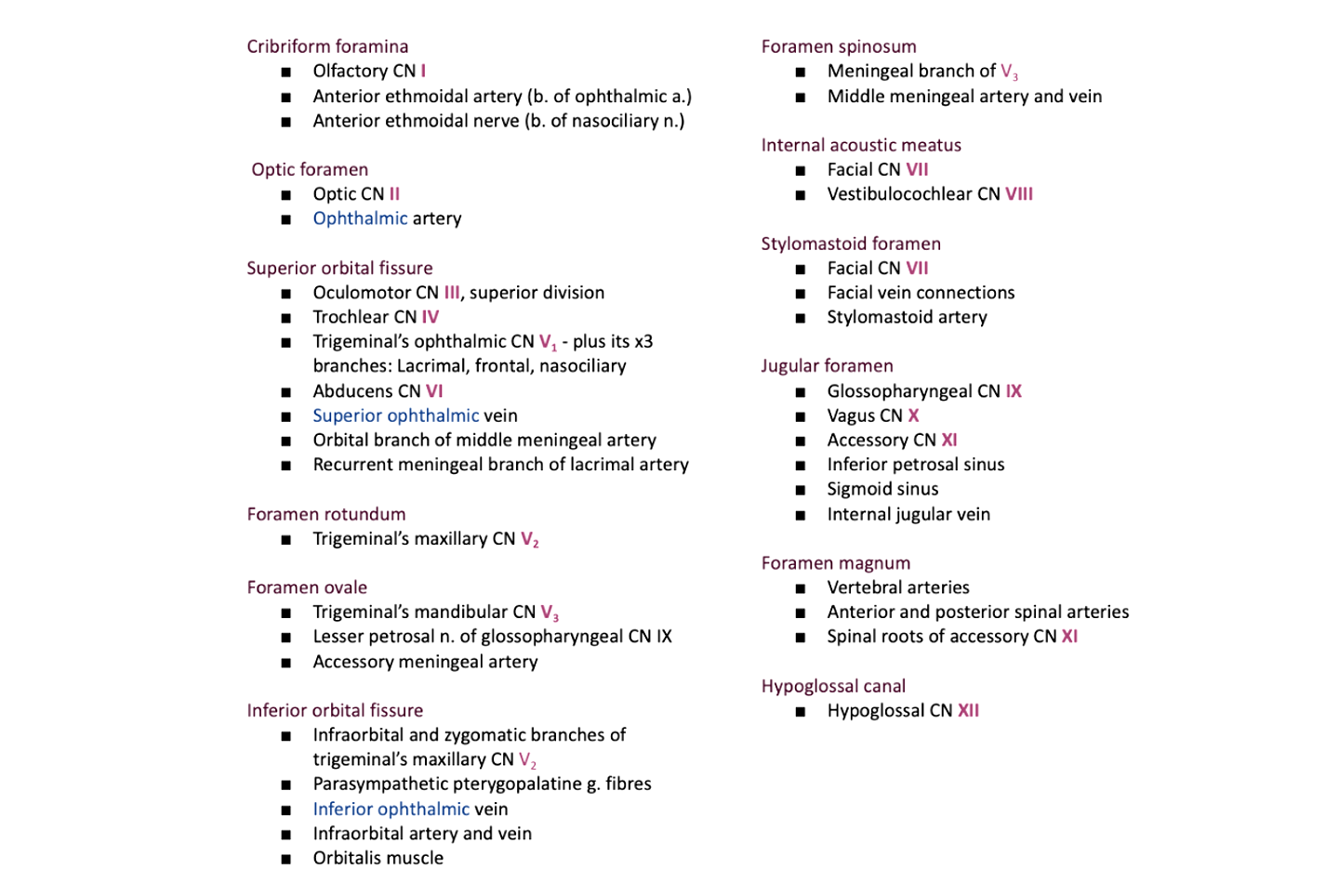
👩⚕️ Here are a couple of exam-style MCQs...
A man presents with ipsilateral facial pain and ophthalmoplegia. Which of these is involved?
- [[Superior orbital fissure::CN III, IV, V1, VI; lesions cause ophthalmoplegia]]
- ((Foramen ovale::Mandibular CN V3))
- ((Foramen rotundum::Maxillary CN V2))
- ((Foramen magnum::Spinal cord, vertebral arteries, and spinal accessory nerve))
Superior orbital fissure lesions present with a combination of symptoms including ophthalmoplegia, ptosis, proptosis, fixed and dilated pupil, and anaesthesia in the forehead, upper eyelid, and cornea.
Through which foramen does the mandibular CN V₃ pass?
- ((Foramen spinosum::Middle meningeal artery))
- [[Foramen ovale::The trigeminal’s mandibular CN V3 exits the skull via the foramen ovale]]
- ((Foramen lacerum::Not a true opening for cranial nerves))
- ((Carotid canal::Internal carotid artery))
- ((Jugular foramen::CN IX, X, XI))
Try to remember SRO corresponds with V1, V2 , V3.
A 25‑year‑old male sustained blunt trauma to the skull while playing football. He is now unable to move half of his face. Where is the most likely location of the facial nerve lesion?
- ((Geniculate ganglion::Would also cause loss of taste and possibly hyperacusis, not isolated motor loss))
- ((Parotid::Injury here tends to affect only certain branches, not the entire half of the face))
- ((Pons::A central lesion would spare the forehead due to bilateral cortical representation))
- [[Stylomastoid foramen::Isolated LMN facial palsy affecting the entire ipsilateral face]]
👩⚕️ And now test yourself using these nice, short Q&As.
A patient presents with weakness of the muscles of mastication. Through which foramen does the nerve pass?
Foramen ovale
The nerve that innervates the muscles of mastication is the mandibular branch of the trigeminal nerve, CN V3, which passes through the foramen ovale.

Through which opening does the facial nerve (CN VII) exit the skull?
Stylomastoid foramen

Which foramen is closest to the pterion and therefore involved in extradural haematoma?
Foramen spinosum
The pterion is the thinnest part of the lateral skull and so easily fractured. The middle meningeal artery (MMA), specifically its anterior branch, runs directly deep to the pterion and enters the skull through the foramen spinosum.
Which nerves run in the lateral wall of the cavernous sinus, adjacent to superior orbital fissure?
CN III, IV, V₁, V₂
Which ganglion is associated with the foramen ovale?
Otic ganglion
This parasympathetic ganglion sits just below the foramen ovale and receives fibres from the lesser petrosal nerve before sending secretomotor fibres to the parotid gland via the auriculotemporal nerve.
Which branch of the trigeminal nerve passes through the infraorbital foramen?
Infraorbital nerve, the terminal branch of trigeminal's maxillary CN V₂.
Which structures pass through the foramen magnum?
Spinal cord, vertebral arteries, spinal roots of the accessory CN XI
Which structures pass through the cribriform plate?
Olfactory CN I fibres
Which foramen transmits both the glossopharyngeal IX, vagus X and accessory XI nerves?
Jugular foramen
Which nerve transverses the hypoglossal canal?
Hypoglossal CN XII
Which foramen transmits the internal carotid artery into the skull?
Carotid canal